
Battery-free sensors close to reality with breakthrough in solar manufacturing
Sensors underpin modern life, but many still rely on disposable batteries which are contributing to a growing waste problem.
With lithium-ion battery waste in Australia projected to exceed 100,000 tonnes by 2036, and hundreds of millions of household batteries discarded each year – many used in low-power indoor sensors and data loggers – there is an urgent need for cleaner power solutions.
Now an NSSN Grand Challenge Fund project has demonstrated a viable pathway to producing a battery-free, sustainable alternative.
Led by Macquarie University researchers, the project achieved a breakthrough in a key manufacturing step for perovskite photovoltaic (PV) cells which can be designed to generate power from ambient light.
The team found a way to manufacture these PV cells faster and more energy-efficient using microwaves: instead of taking 30 minutes, it now takes about 30 seconds and uses half the energy.
They also worked out how to scale the process for real manufacturing, where material is produced continuously on a moving roll.
“If this technology can be scaled, it unlocks sensing applications that simply aren’t viable today, such as sensors embedded in concrete, environmental monitors in remote infrastructure, long-term medical devices, and agricultural sensing under greenhouse lighting, all operating continuously without maintenance,” Project Lead and Senior Lecturer in the School of Engineering at Macquarie University, Dr Binesh Veettil says.
The breakthrough uses a microwave-based process to reduce perovskite PV cell annealing from around 30 minutes to about 30 seconds while significantly cutting energy use, enabling fast, scalable manufacturing and supporting future low-cost, self-powered indoor sensor applications.
The project also opens the door to more flexible production where perovskite PV cells could one day be printed and integrated into materials like packaging, buildings and clothing rather than just manufactured for traditional panels.
“The real barrier has always been the cost and complexity of battery replacement, but once each sensor is self-powered, dense networks with tens of thousands of sensors become practical,” Dr Veettil says.
“With indoor-light-optimised perovskite cells, which are highly efficient in low light and can be printed directly into devices, we can move to truly ‘install-and-forget’ sensors with no need for separate panels or additional engineering to integrate them.”
A major focus of the project was 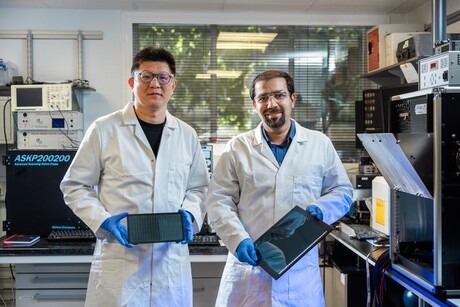 adapting the process for high-speed production, essential for low-cost, large-scale deployment.
Dr Veettil says the project’s main challenges were scaling the process to continuous roll-to-roll manufacturing, where material is produced on a moving surface like printing, and achieving uniform heating over a large area.
The team overcame two key challenges: managing the naturally uneven distribution of microwave fields to ensure uniform heating, and delivering sufficient energy within the few seconds the material spends in the system.
“One of the key challenges was that microwaves naturally produce uneven heating, so we had to engineer a system that spreads energy more evenly and works reliably across a moving surface rather than just small lab samples,” he says.
“We addressed this by using continuously varying frequencies and a specially designed cavity to reduce hot and cold spots, allowing us to achieve consistent results.
“The key outcome was showing that microwave annealing can be made robust enough for continuous, industrial-scale manufacturing rather than remaining a lab-based technique.”
The project was conducted in partnership with co-investigator Dr Robert Patterson from the School of Photovoltaic and Renewable Energy Engineering at UNSW.
“In energy-constrained applications from sensing and portable devices to unmanned aerial vehicles (UAVs), every watt of on-board generation is a game changer,” Dr Patterson says.
“Self-powered sensors remove some key energy storage barriers and make dense, large-scale sensor networks more viable.”
Dr Patterson says the implications for sustainability are significant.
“Even partial adoption of portable generation for devices like sensors would greatly extend battery lifetime, diverting millions of batteries from landfill each year.”
The industry partner in the project was Halocell Energy Ltd, a world leader in indoor perovskite PV and one of the few companies globally manufacturing flexible perovskite cells at commercial scale.
Chief Technology Officer at Halocell Energy Ltd, Dr David Pham says the project has demonstrated the feasibility of microwave-based processing for perovskite solar cells, supporting its ambition to develop low-cost, high-throughput manufacturing for indoor photovoltaic applications.
“This project has demonstrated a clear pathway toward commercial deployment, with microwave-based processing showing strong potential for integration into high-throughput manufacturing,” Dr Pham says.
“The collaboration with Macquarie University has been highly productive, and we look forward to progressing this technology through scale-up and pilot testing.”
Looking ahead, the next steps in the project include extended production trials, lifetime testing and scaling the technology for commercial deployment. Early applications, such as electronic shelf labels, could reach market within three to five years.
The project has also established a dedicated microwave annealing facility at Macquarie University, enabling new areas of research extending beyond perovskite materials to other thin-film semiconductors, 2D materials and oxide electronics.
“Microwave processing isn’t limited to perovskites: it can be applied to a wide range of advanced materials where rapid, selective heating is needed, and it provides industry with a capability that is difficult to find elsewhere in Australia,” Dr Veettil says.


