Rhino Linings help minimise water treatment plant degradation and chemical spills
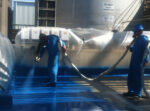
For more than half a century, municipal councils, as well as industrial and mining companies throughout Australia and New Zealand have invested billions of dollars into equipment and infrastructure to process waste water and sewage. Corrosion of this infrastructure, and in some cases the subsequent leakage, costs industry in excess of $1B each year. The main assets that are impacted by corrosion in waste water treatment plants (WWTP) are the pipelines, storage tanks, clarifier ponds and sewage channels. As much of the WWTPs infrastructure is ageing, it is starting to require refurbishment or replacement. One method of refurbishment of these assets is to carry out surface repairs and then apply protective coatings. These coatings must be strong, flexible and resistant to chemical attack. Corrosion particularly affects the submerged parts of structures in WWTPs. “Special consideration has to be given when coating structures in sewage treatment plants,” stated Dennis Baker, Special Projects Engineer at Gold Coast-based Rhino Linings Australasia (RLA). “One of the more corrosive by-products of sewage is hydrogen sulphide gas.” “Hydrogen sulphide reacts with moisture on surfaces in a waste water plant and bubbles up to form sulphuric acid which really loves concrete,” added Baker. Hydrogen sulphide (H2S) attacks the cement, copper, iron and silver which gradually degrades the structure. In the case of a pipeline, this may ultimately result in the collapse of the pipe wall. The modern requirement for capping storages in order to control excessive odours has the drawback of also increasing gas concentrations. One type of coating from RLA that is ideally suited for waste water treatment is spray applied Polyurea. The company has been working with this material since the early 1990s and now manufactures in Australia a range of consistent formulations which are suitable for a variety applications. Pure Polyurea is a relatively […]