|
Weld Australia says renewable infrastructure build-out can unlock jobs, capability and regional industrial growth
Weld Australia has welcomed growing momentum behind domestic wind and transmission tower manufacturing, describing it as one of the most significant industrial opportunities available to Australia’s fabrication, steel and manufacturing sectors.
The Federal Government’s most recent Capacity Investment Scheme results demonstrate the scale of the opportunity. Announced in late May, Tender 7 selected 19 projects and exceeded the original 5GW target by more than 50%. The projects will deliver 7.8GW of generation capacity, which is enough to power four million households across the National Electricity Market, with associated hybrid projects adding a further 7.9GWh of storage capacity.
According to Weld Australia CEO Geoff Crittenden, the scale of this build-out presents a direct opportunity for Australian industry.
“This is not an abstract future opportunity. It is happening now,” Crittenden said. “Every wind farm needs towers. Every transmission project needs steel. Every major energy project requires fabrication, welding, logistics, engineering and skilled workers. These are exactly the capabilities Australian industry already has.”
The Federal Government has already recognised the potential, with the Department of Industry, Science and Resources recently consulting on domestic manufacturing of wind and transmission infrastructure. The Department stated that Australia has a “unique opportunity to build a competitive, viable and resilient domestic manufacturing industry for wind and transmission towers.”
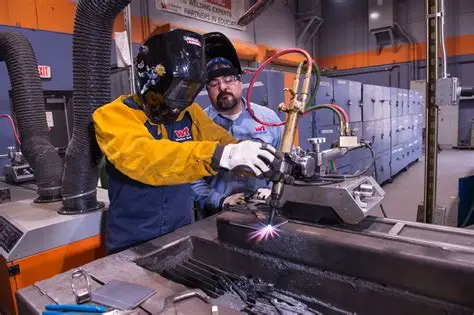 Weld Australia is now calling for practical policy settings that convert opportunity into long-term industrial capability. Weld Australia is now calling for practical policy settings that convert opportunity into long-term industrial capability.
“Australia has a choice,” Crittenden said. “We can import the majority of the fabricated steel components needed for the energy build-out, or we can use this pipeline of work to rebuild manufacturing capability, create skilled jobs, support regional communities and strengthen supply chains.”
The opportunity is already being demonstrated on the ground. At Squadron Energy’s Uungula Wind Farm in NSW, Western Sydney-based Precision Oxycut fabricated the steel plates for 69 wind turbine anchor cages using 100% Australian steel supplied by BlueScope from Port Kembla. Allthread Industries manufactured the bolts, with assembly completed at Oxycut’s Newcastle warehouse. The project created six new jobs at Precision Oxycut and helped re-establish apprenticeship pathways that had not existed in the factory for decades.
“Uungula shows what is possible when Australian steel, Australian fabrication and Australian project developers work together,” Crittenden said.
“The anchor cages are only part of the opportunity. The real prize is wind towers and transmission towers—the large-scale fabricated steel components that can sustain workshops, apprenticeships, engineering teams and regional industrial communities for decades.”
Weld Australia has been leading an industry working group involving organisations across the steel, fabrication and wind supply chains, including BlueScope, Goldwind Australia, Oxycut, Prince Engineering, Tilt Renewables, Acciona, Nordex and Vestas. The group has developed a four-pillar policy framework designed to unlock competitive local manufacturing capability.
The framework proposes:
- Stable demand: domestic wind quota ramping up to ~4.3GW per year, matching 2035 emissions target, creating known wind power demand via CIS or equivalent. This would give manufacturers the pipeline certainty required to invest.
- Local content mandate: A clear 20% local content mandate for wind tower sections in Australian wind projects, to drive local demand, underpinned by a local wind tower certificate scheme.
- Incentives: Manufacturing Production Credit ($/tonne) to offset local towers cost and maintain wind competitiveness.
- Capability investment: capital grants to uplift and establish greenfield manufacturing capability in regional locations, with opportunities for the Australian and state governments to drive regional outcomes.
Weld Australia understands that the framework is now being favourably reviewed through Cabinet processes.
“Minister for Industry and Innovation, Tim Ayres, has provided strong support for the scheme and is doing everything possible to see it implemented,” Crittenden said.
“Minister Ayres understand that this is exactly the type of practical, industry-led policy Australia needs. It is not about slogans. It is about demand certainty, investment confidence and creating a market that allows Australian manufacturers to compete.”
Modelling for a regional NSW facility indicates the potential to create hundreds of direct and indirect jobs and generate up to $2.7 billion in additional economic activity across NSW between 2027 and 2040.
“The numbers show this can be done sensibly,” Crittenden said. “With the right scale, the right policy settings and the right pipeline, Australia can manufacture wind and transmission towers competitively. The benefit is not just the tower itself. It is the supply chain, the skills, the apprenticeships, the engineering capability and the confidence for businesses to invest.”
Crittenden said the policy framework could also be extended beyond wind towers to transmission infrastructure and other large-scale steel-intensive energy assets. “This is about rebuilding industrial capability,” Crittenden said. “Wind towers are the starting point, but the same skills, plant and supply chains can support transmission towers and other major fabricated infrastructure.”
Weld Australia is urging the Federal Government to move quickly. “Industry is ready. The project pipeline is emerging. Cabinet is engaged. Now we need policy certainty,” Crittenden said. “If we get this right, Australia can build a competitive domestic wind and transmission tower industry. If we delay, the work will go offshore and the opportunity will be lost.”
Weld Australia represents the welding profession in Australia. Its members are made up of individual welding professionals and companies of all sizes. Weld Australia members are involved almost every facet of Australian industry and make a significant contribution to the nation’s economy. The primary goal of Weld Australia is to ensure that the Australian welding industry remains locally and globally competitive, both now and into the future. Weld Australia is the Australian representative member of the International Institute of Welding (IIW). For more information or to join Weld Australia, please visit: https://weldaustralia.com.au/ |



